Rumore
 Italy
Italy
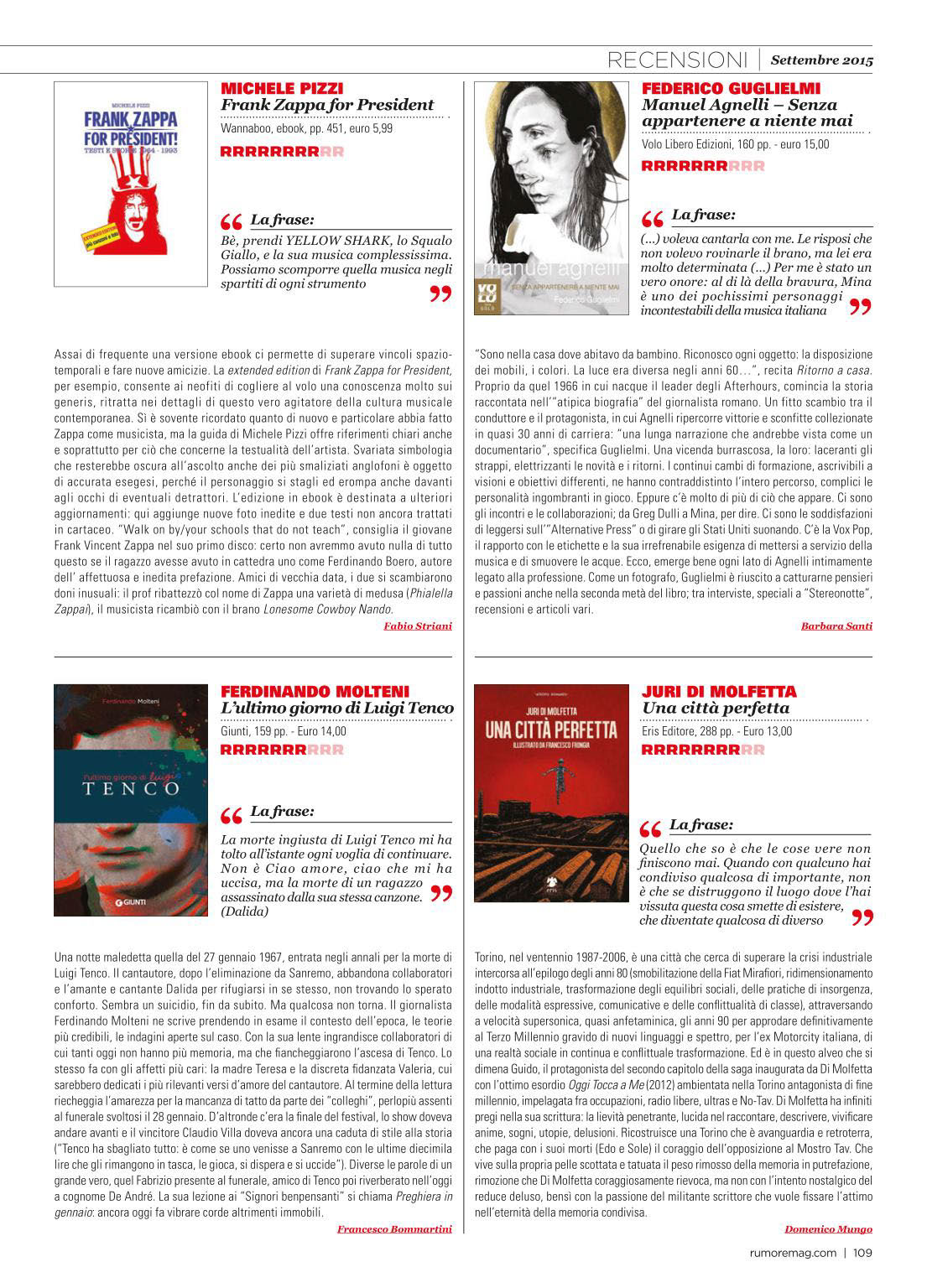
Review of the new and expanded ebook version of Michele Pizzi's book Frank Zappa for President.
Automatic translation:
Quite often, an ebook version allows us to transcend space-time
constraints and make new friends. The extended edition of Frank
Zappa for President, for example, allows newcomers to quickly
grasp a very unique understanding, portrayed in detail by this
true agitator of contemporary musical culture. While it's often
been mentioned how innovative and unique Zappa was as a musician,
Michele Pizzi's guide offers clear references, especially regarding
the artist's lyrical content. A variety of symbolism that would
remain obscure to even the most seasoned English speakers is
carefully exeged, allowing the character to stand out and emerge
even before the eyes of potential detractors. The ebook edition
is destined for further updates; here, it adds new, previously
unpublished photos and two texts not yet covered in print. "Walk
on by/your schools that do not teach," advises the young Frank
Vincent Zappa on his first album. We certainly wouldn't have
had any of this if the boy had had someone like Ferdinando Boero,
author of the affectionate and previously unpublished preface,
in his classroom. Longtime friends, the two exchanged unusual
gifts; the professor renamed a variety of jellyfish (Phialella
Zappai) after Zappa, and the musician reciprocated with the
song "Lonesome Cowboy Nando."
Rating: 8/10
Automatic translation:
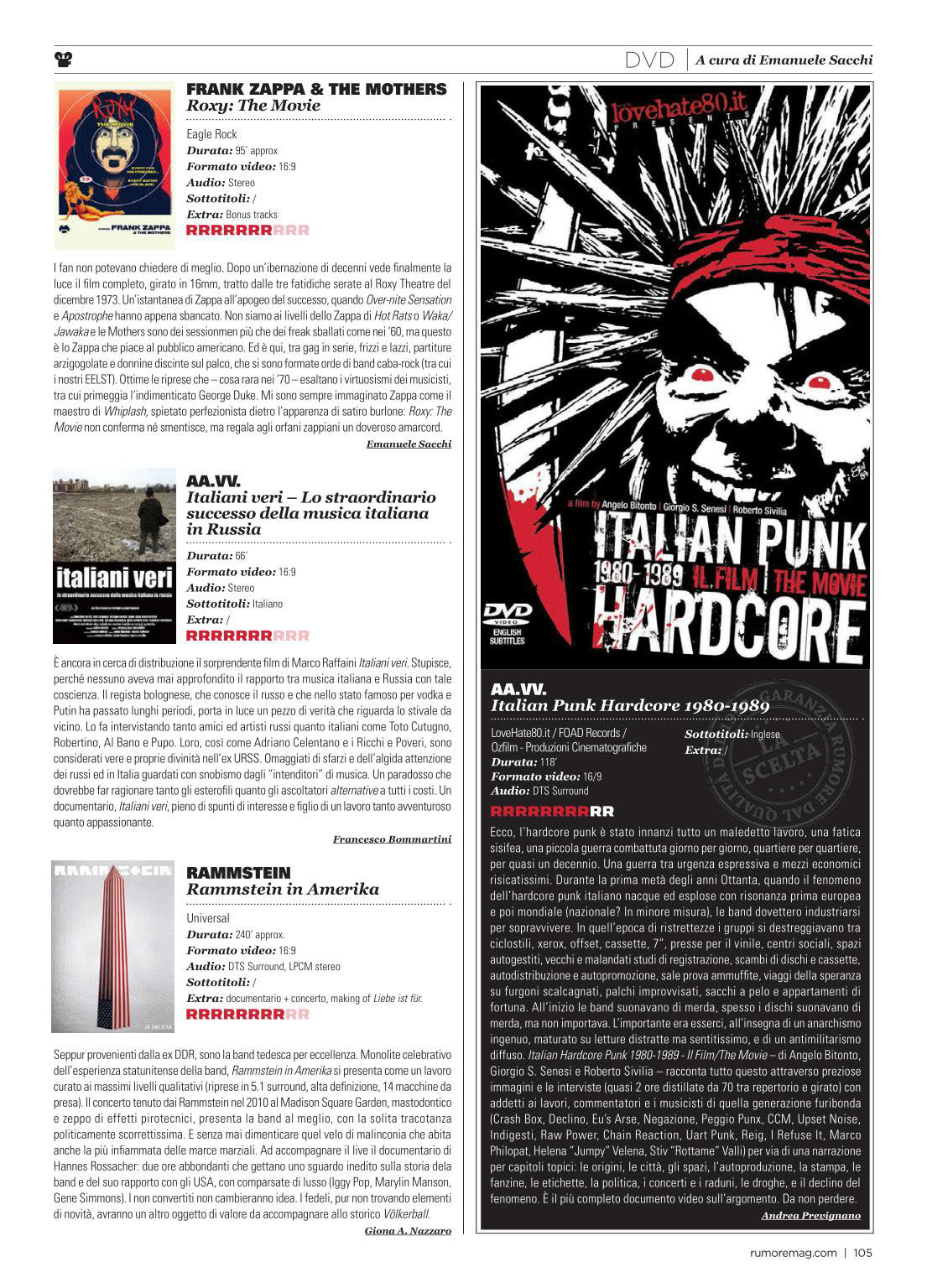
Fans couldn't have asked for more. After decades of hibernation,
the complete film, shot on 16mm, based on the three fateful
nights at the Roxy Theatre in December 1973, is finally being
released. It's a snapshot of Zappa at the height of his success,
when Over-nite Sensation and Apostrophe had
just become a smash hit. We're not at the level of the Zappa
of Hot Rats or Waka/Jawaka, and the Mothers
are more session musicians than the '60s freaks, but this is
the Zappa that American audiences like. And it's here, amidst
serial gags, quips and jests, convoluted scores, and scantily
clad women on stage, that hordes of caba-rock bands were formed
(including our own EELST). The excellent filming – rare in the
'70s – highlights the virtuosity of the musicians, especially
the unforgettable George Duke. I've always imagined Zappa as
the master of Whiplash, a ruthless perfectionist behind
the guise of a prankster satyr: Roxy: The Movie neither
confirms nor denies, but it does provide Zappa's orphans with
a well-deserved reminiscence.
Rating: 7/10
Automatic translation:
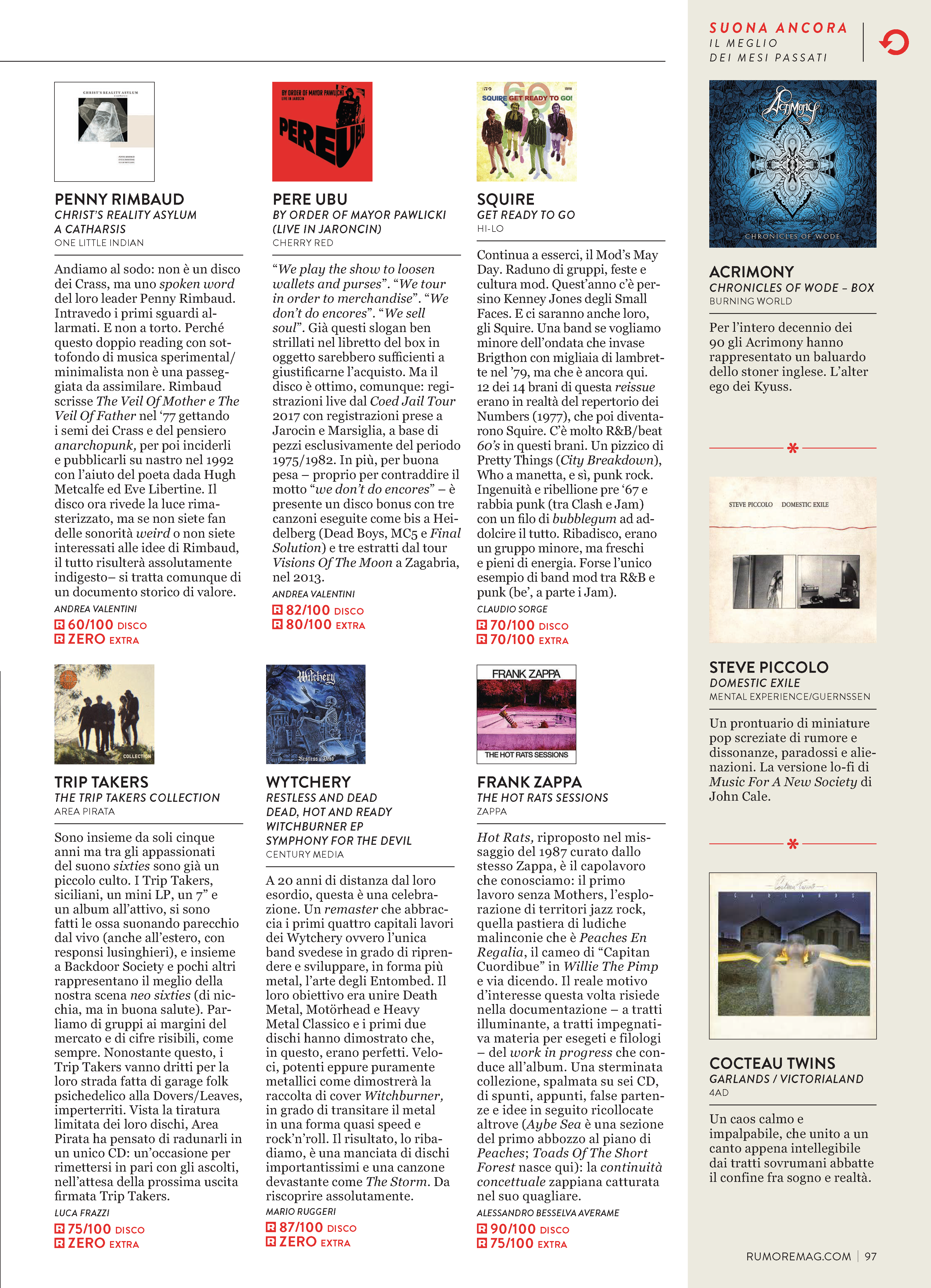
Hot Rats, re-released in the 1987 mix curated by Zappa himself,
is the masterpiece we know: the first work without Mothers,
the exploration of jazz-rock territory, that pastiera of playful
melancholy that is Peaches En Regalia, the cameo of
Captain Beefheart on Willie The Pimp and so on. The
real interest this time lies in the documentation – at times
illuminating, at times challenging material for exegetes and
philologists – of the work in progress that led to the album.
An immense collection, spread across six CDs, of cues, notes,
false starts and ideas later relocated elsewhere (Aybe Sea
is a section of the first piano sketch of Peaches;
Toads Of The Short Forest originates here): Zappa's
conceptual continuity captured in its coagulation.
Rating: disc 90/100 extra 75/100
Automatic translation:
In short: the 1970 reboot of the Mothers, revisited in 70 unreleased
tracks (some absolutely unreleased) spread across four CDs.
The setlist includes a stop at London's Trident Studios (the
same sessions would yield part of Chunga's Revenge),
a concert broadcast by Dutch radio station VRPO, and various
other scattered recordings mostly captured – on stage and in
dressing rooms – on Zappa's Uher portable recorder, with limited
battery life but good sound quality. The result is a portrait
of a band short-lived (bassist Jeff Simmons would leave during
the making of the film 200 Motels), with Flo &
Eddie not yet absolute stars (a good thing for this writer),
effective in reinterpreting the recent past and outlining a
new Zappa direction.
Rating: disc 70/100 extra 0
2020 October
No. 345
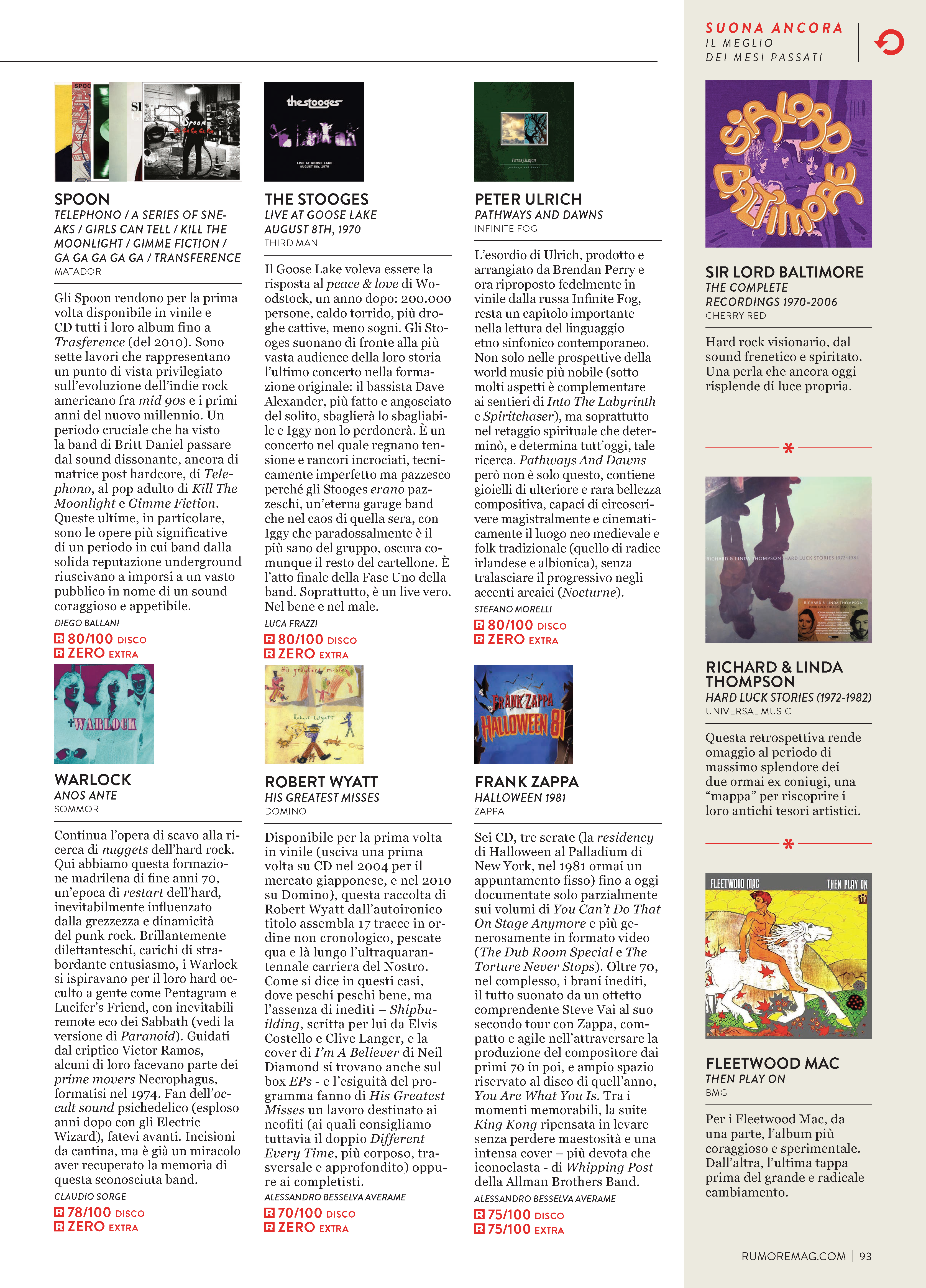
Frank Zappa - Halloween 1981
By Alessandro Besselva Averame, p 93
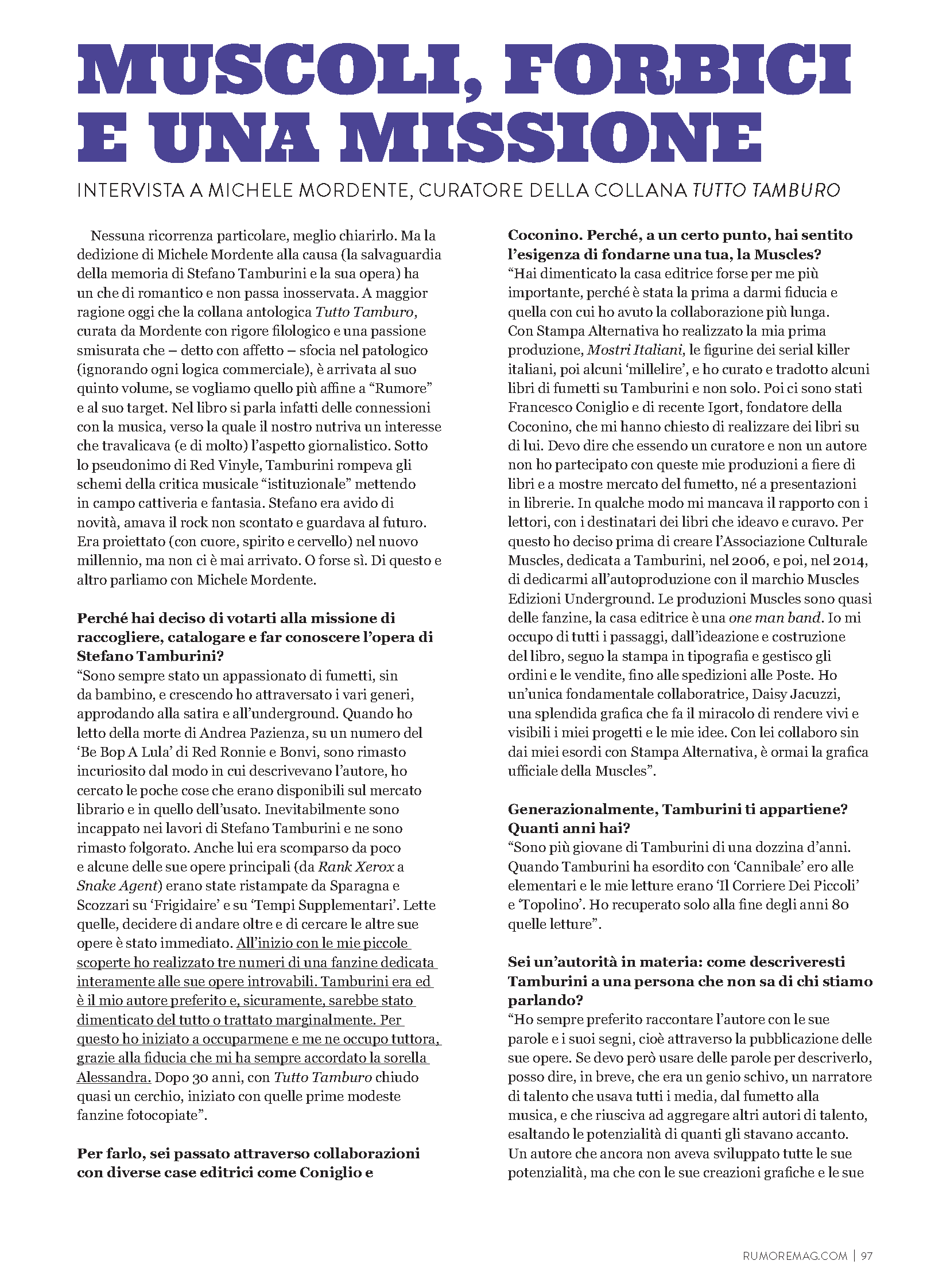
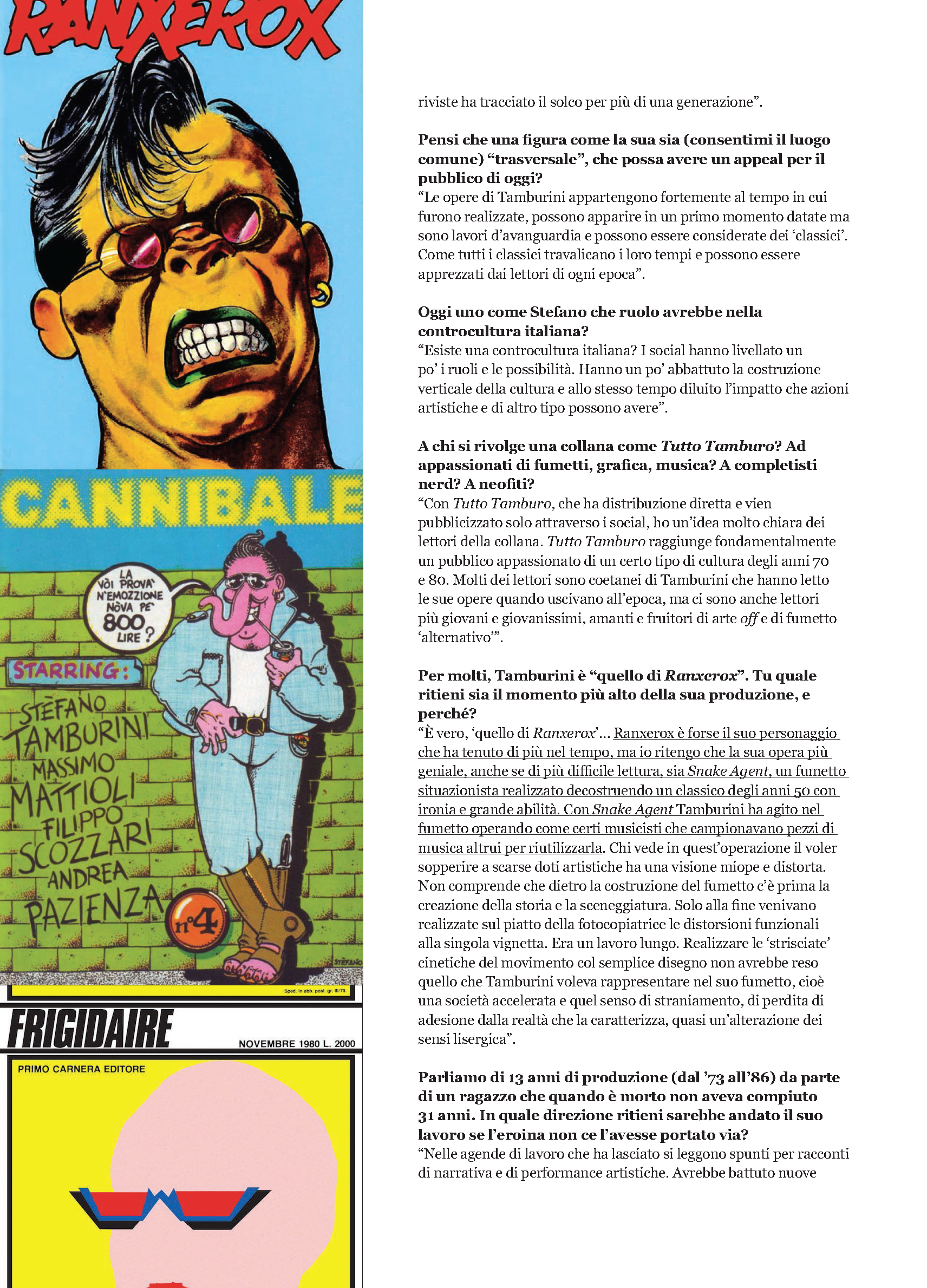
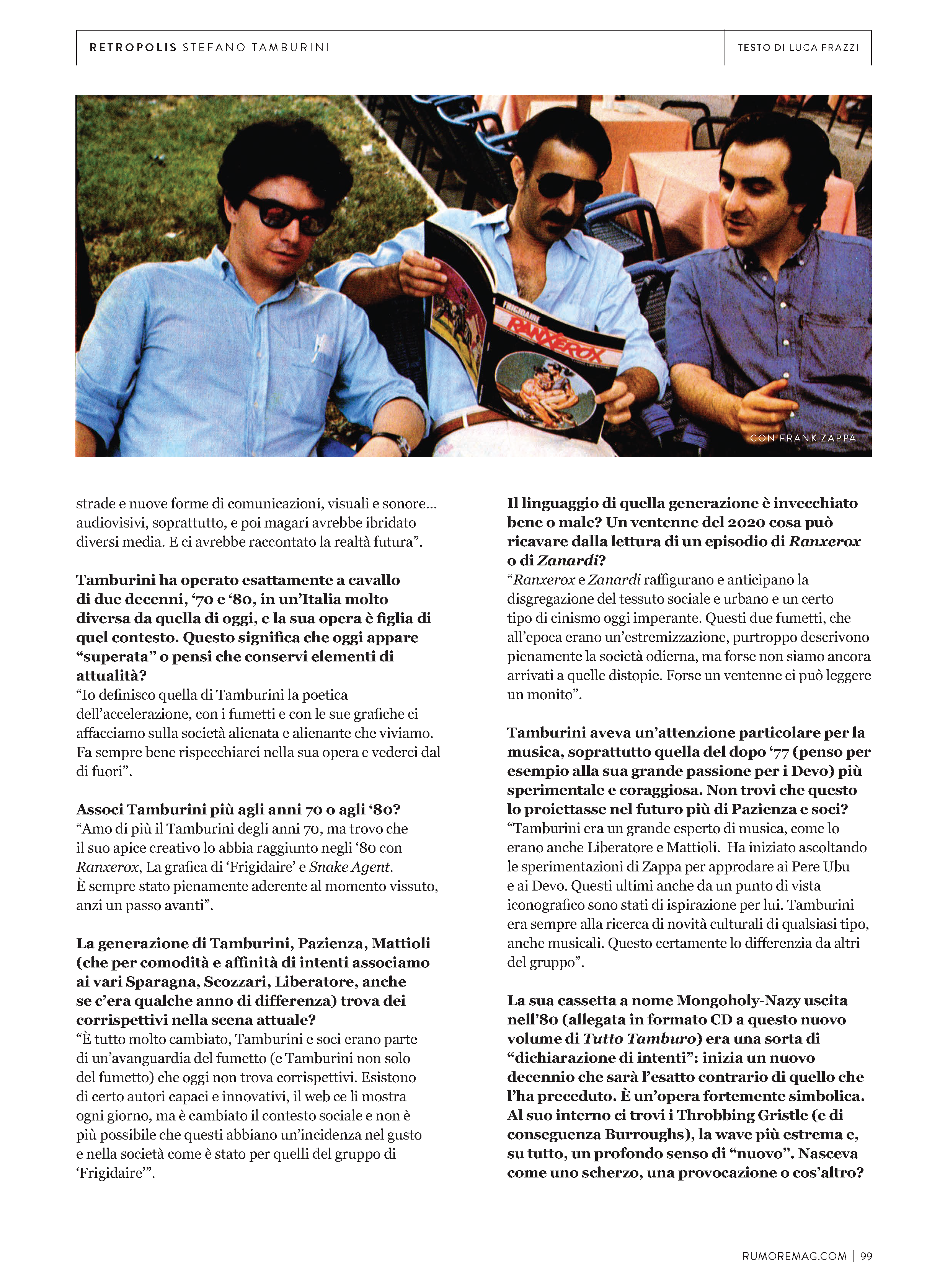
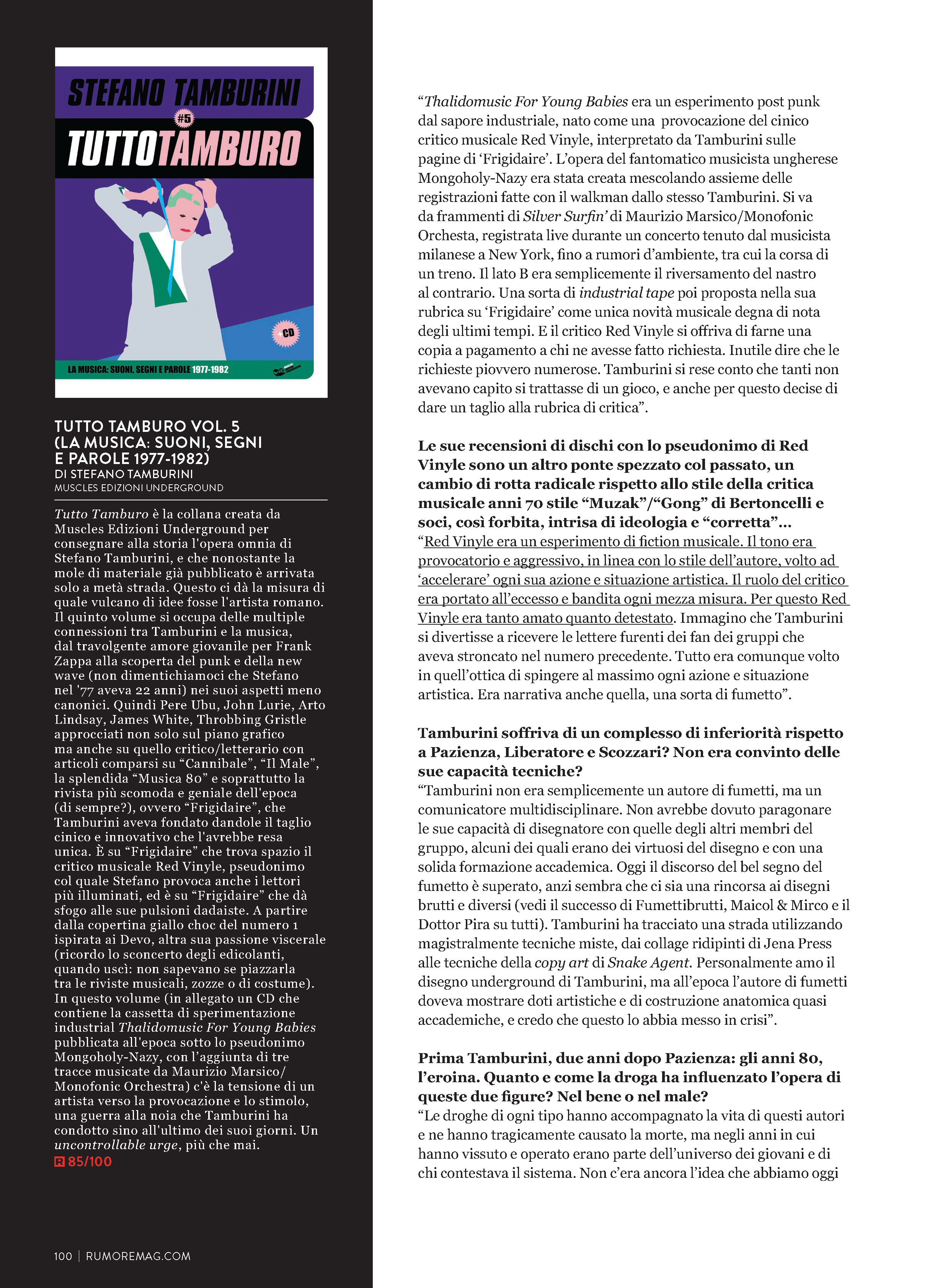
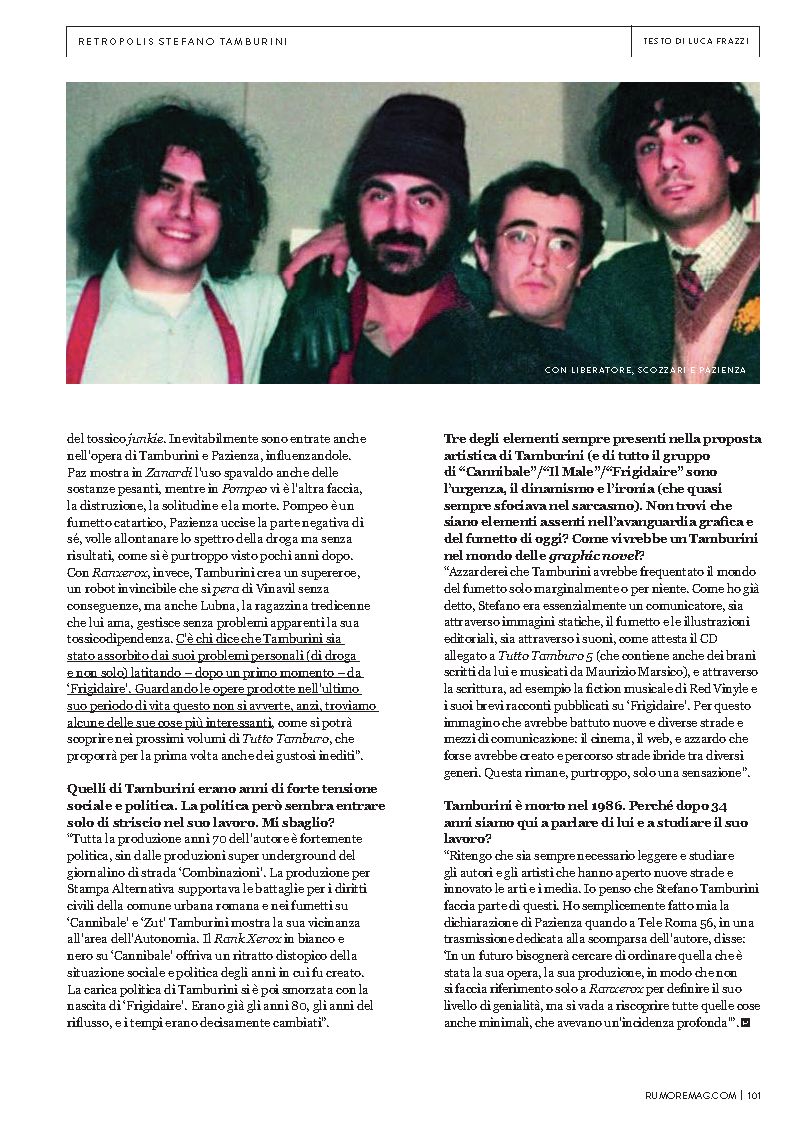
Muscoli, forbici e una missione (Muscles, scissors,
and a mission)
Interview with Michele Mordente, curator of the
Tutto Tamburo
series
By Luca Frazzi, pp 97-101
Automatic translation:
Six CDs, three nights (the Halloween residency at the Palladium
in New York in 1981, now a regular event) until now only partially
documented on the You Can’t Do That On Stage Anymore
volumes and more generously in video format (The Dub Room
Special and The Torture Never Stops). Over 70
unreleased songs in total, all performed by an octet including
Steve Vai on his second tour with Zappa, compact and agile in
traversing the composer’s output from the early 70s onward,
with ample space dedicated to that year’s album, You Are
What You Is. Among the memorable moments are the King
Kong suite, reimagined on the upbeat without losing its
majesty, and an intense cover – more devout than iconoclast
– of the Allman Brothers Band’s Whipping Post.
Rating: disc 75/100 extra 75/100
2021 December
No. 343
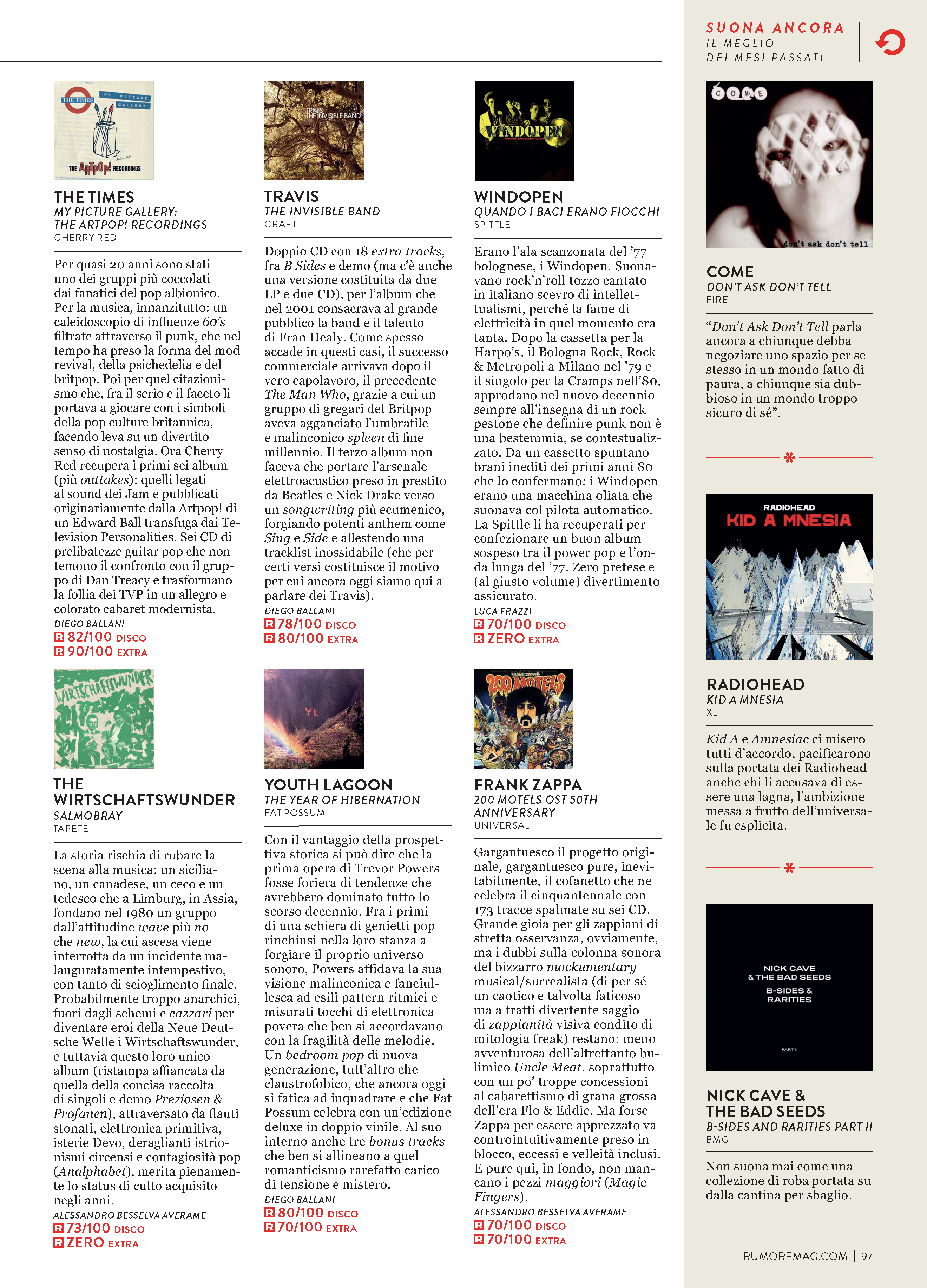
Frank Zappa - 200 Motels 50th Anniversary
By Alessandro Besselva Averame, p 97
Automatic translation:
The original project is gargantuan, and so too, inevitably,
is the box set celebrating its fiftieth anniversary, with 173
tracks spread across six CDs. A great joy for Zappa fans of
strict observance, of course, but doubts remain about the soundtrack
of this bizarre musical/surrealist mockumentary (itself
a chaotic and at times laborious yet occasionally entertaining
piece of Zappa visual art peppered with freak mythology): less
adventurous than the equally bulimic Uncle Meat, especially
with a few too many concessions to the coarse cabaret of the
Flo & Eddie era. But perhaps, to be appreciated, Zappa must
be counterintuitively taken as a whole, excesses and ambitions
included. And even here, after all, there is no shortage of
highlights (Magic Fingers).
Rating: disc 70/100 extra 70/100
Automatic translation:
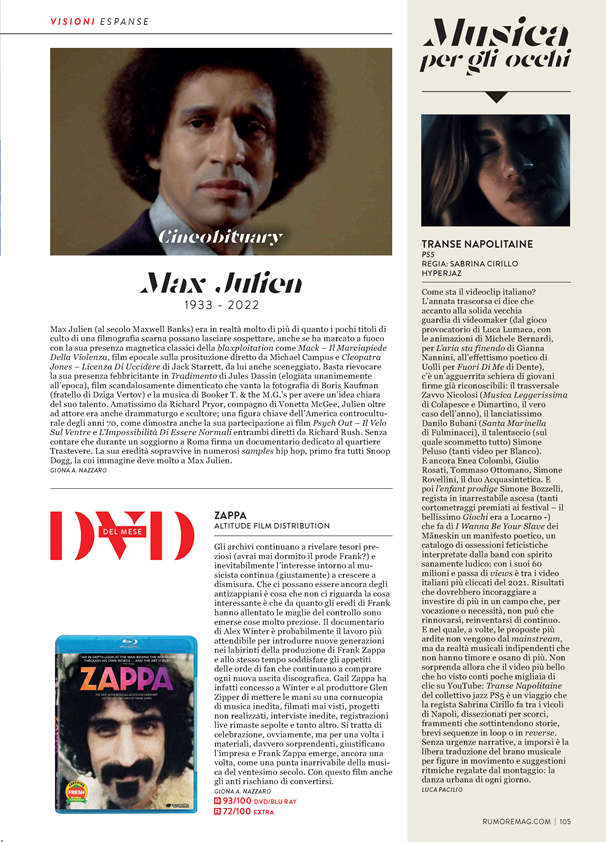
The archives continue to reveal precious treasures (did you
ever sleep with the brave Frank?), and inevitably, interest
in the musician continues (rightly) to grow beyond measure.
Whether there may still be anti-Zappa fans is beyond our control;
the interesting thing is that since Frank's heirs have loosened
the grip on control, some very valuable things have emerged.
Alex Winter's documentary is probably the most reliable work
to introduce new generations to the labyrinthine depths of Frank
Zappa's output while simultaneously satisfying the appetites
of the hordes of fans who continue to buy every new record release.
Gail Zappa has, in fact, allowed Winter and producer Glen Zipper
to get their hands on a cornucopia of unreleased music, never-before-seen
footage, unrealized projects, unreleased interviews, buried
live recordings, and much more. It's a celebration, of course,
but for once the truly astonishing material justifies the effort,
and Frank Zappa emerges, once again, as an unrivaled force in
twentieth-century music. With this film, even the anti-government
members risk converting.
Rating: DVD 93/100 extra 72/100
Automatic translation:
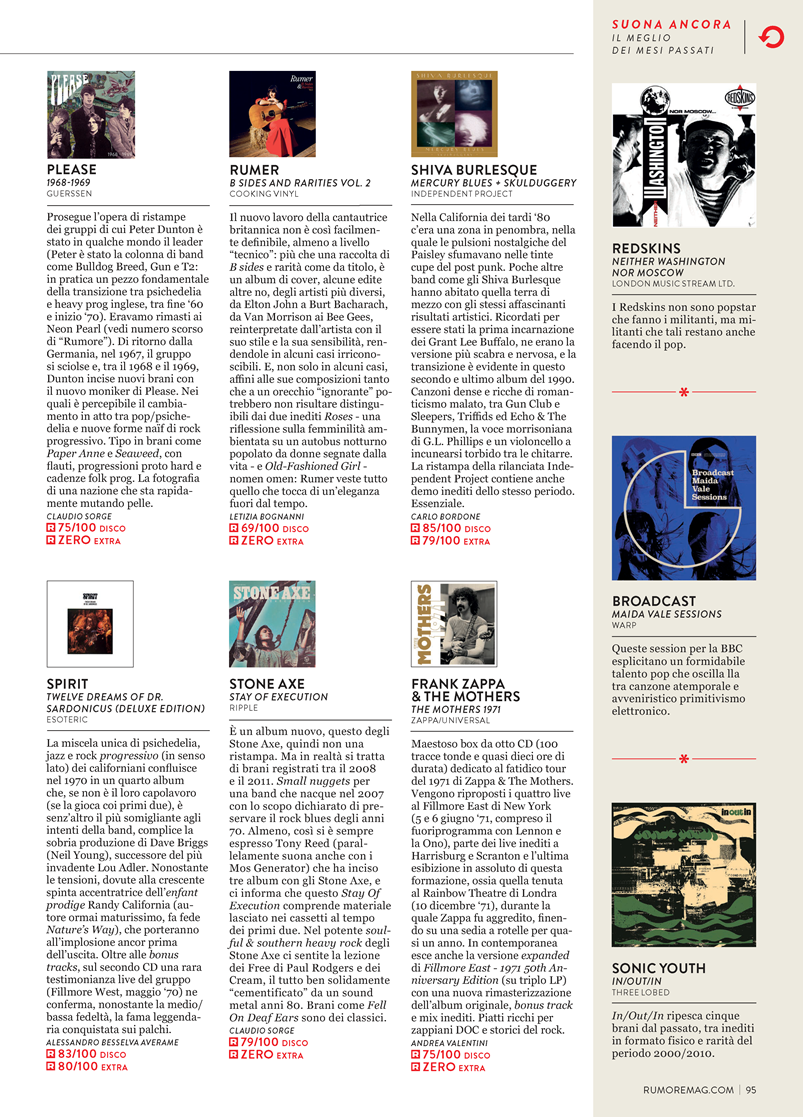
A majestic eight-CD box set (100 tracks and nearly ten hours
of playing time) dedicated to Zappa & The Mothers' fateful
1971 tour. It features the four shows at the Fillmore East in
New York (June 5 and 6, 1971, including the unscheduled performance
with Lennon and Ono), some previously unreleased performances
in Harrisburg and Scranton, and the band's final performance,
the one at the Rainbow Theatre in London (December 10, 1971),
during which Zappa was attacked and confined to a wheelchair
for nearly a year. Also released simultaneously is the expanded
version of Fillmore East - 1971 50th Anniversary Edition (on
a triple LP) featuring a newly remastered original album, bonus
tracks, and previously unreleased mixes. A rich offering for
Zappa aficionados and rock historians.
Rating: disc 75/100 extra 0
Automatic translation:
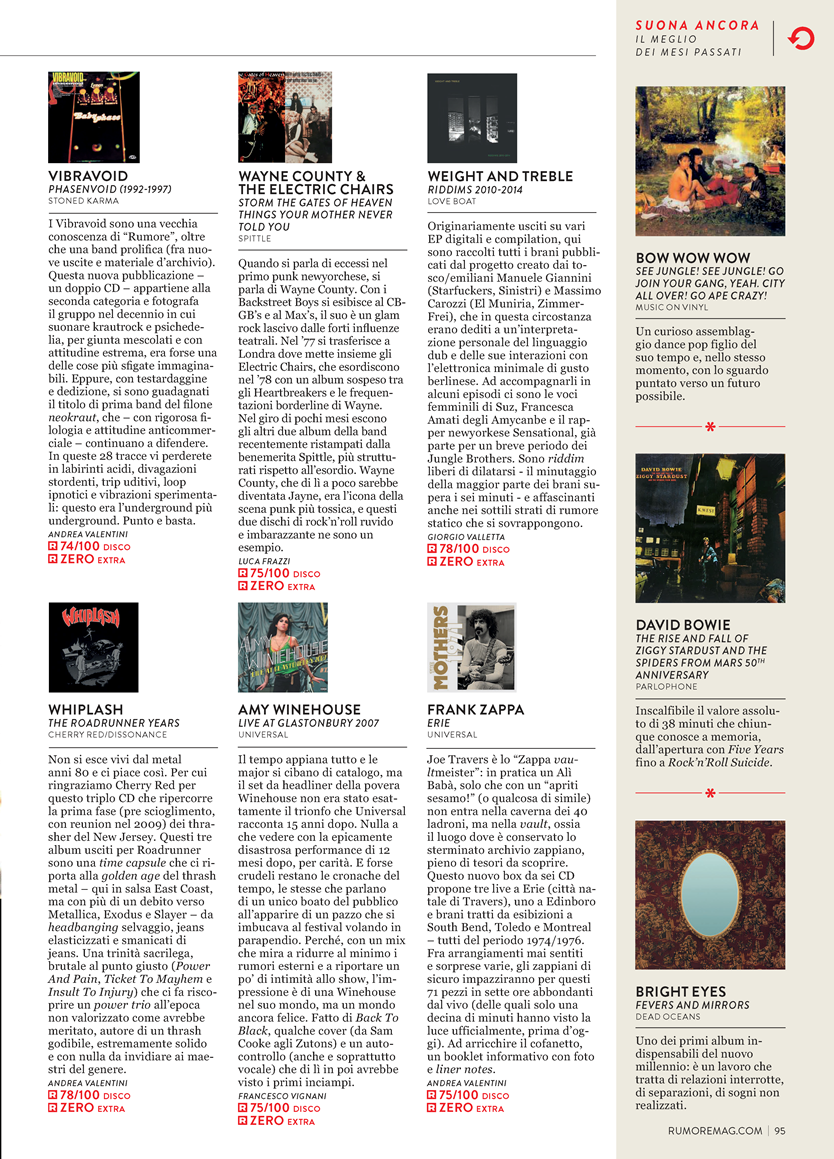
Joe Travers is the "Zappa vaultmeister": basically an Ali Baba,
except that with a "Open Sesame!" (or something similar), he
doesn't enter the cave of the 40 thieves, but the vault, the
place where Zappa's vast archive is kept, full of treasures
waiting to be discovered. This new six-CD box set features three
live performances in Erie (Travers' hometown), one in Edinboro,
and tracks from performances in South Bend, Toledo, and Montreal—all
from 1974/1976. Featuring never-before-heard arrangements and
various surprises, Zappa fans are sure to go wild for these
71 tracks spanning a full seven hours of live performances (only
about ten minutes of which have been officially released before
today). The box set also includes an informative booklet with
photos and liner notes.
Rating: disc 75/100 extra 0
Automatic
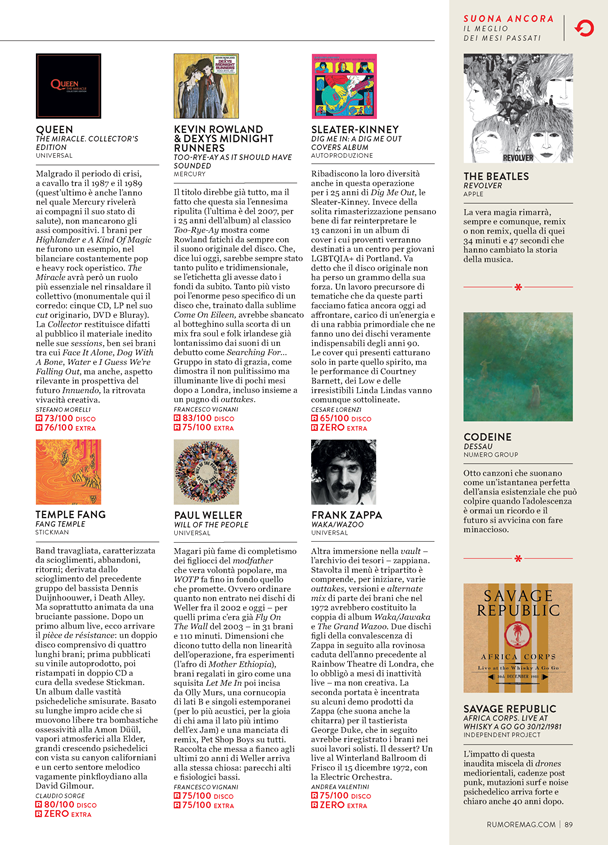
translation: Another dive into Zappa's vault - the archive
of treasures. This time, the menu is three-part, starting
with various outtakes, versions, and alternate mixes of
parts of the songs that would comprise the 1972 album duo
Waka/Jawaka and The Grand Wazoo. These two
albums were the product of Zappa's convalescence following
his disastrous fall the previous year at London's Rainbow
Theatre, which forced him into months of live - but not
creative - inactivity. The second course focuses on several
demos produced by Zappa (who also plays guitar) for
keyboardist George Duke, who would later rerecord the songs
for his solo albums. Dessert? A live performance at Frisco's
Winterland Ballroom on December 15, 1972, with the Electric
Orchestra.
Rating: disc 75/100 extra 0